Chinese
 English

|
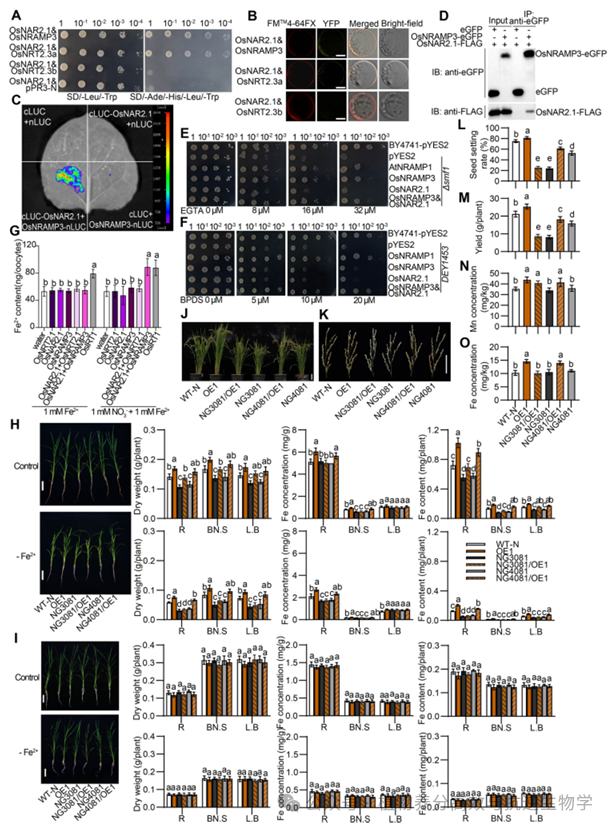
A partner protein helps OsNRAMP3 win a novel function to transport Fe2+ in rice📚Research Background Iron deficiency anemia is one of the most common nutritional deficiencies globally, affecting over one billion people. As the staple food for aproximately 50% of the world's population, rice grains generally have low iron content, and their absorption by the human body is limited, making populations dependent on rice more susceptn deficiency. Plants primarily absorb Fe²⁺ or Fe³⁺ from the soil through their root systems. Although rice has evolved multiple iron absorption mechanisms, iron uptake and translocation remain restder specific conditions, such as low nitrate levels. Previous studies have shown that OsNAR2.1 is a nitrate transporter partner protein that primarily assists the high-affi transporter OsNRT2.1; its overexpression can enhance nitrogen uptake efficiency and yield in rice. In contrast, OsNRAMP3 is a manganese transporter responsible for allocating ese to young leaves, and it has not previously been reported to possess iron transport capabilities. An intriguing question arises: could the cooperation of these two proteins lead to a breakthrough in iron nutriton for rice? Article Content This study reveals that the rice nitrate transporter partner protein OsNAR2.1 confers a new Feort function to Natural Resistance-Associated Macrophage Protein 3 (OsNRAMP3) by interacting with it. OsNRAMP3 originally functions in manganese allocation and is notlved in iron transport. Yeast two-hybrid, bimolecular fluorescence complementation, luciferase complementation, and co-immunoprecipitation experiments confirmed their direct inton. In yeast and oocyte systems, co-expression of OsNAR2.1 and OsNRAMP3 significantly enhanced Fe²⁺ uptake, and this process depended on the presenc of nitrate. Under low nitrate conditions, OsNRAMP3 mutants exhibited disordered iron and manganese uptake and allocation, along with reduced biomass. Overexpression.1 increased plant iron and manganese content as well as yield, but this effect disappeared in OsNRAMP3 complete knockout lines. OsNAR2.1 may activate the iron uptakenction of OsNRAMP3 by promoting its transport from the endoplasmic reticulum to the plasma membrane. This study provides a new strategy for breeding high-iron anh-yield rice using the OsNAR2.1-OsNRAMP3 module. 🔍 Figure and Text Analysis The research team systematically verified the interaction between AR2.1 and OsNRAMP3 through a series of experiments and demonstrated that this interaction confers Fe²⁺ transport activity to the latter. 1️⃣ Interaction Verification: Consistent proof from fourxperiments Researchers used Yeast Two-Hybrid (Y2H), Bimolecular Fluorescence Complementation (BiFC), Luciferase Complementation (LCIand Co-Immunoprecipitation (Co-IP) to confirm the direct interaction between OsNAR2.1 a
Functional characterization of OsNRAMP3 in rice Fe2+ transport 2️⃣ Functional validation reveals that yeast iron uptake is restored only upon co-expression In the iron uptake-deficient yeast mtant DEY1453, expression of OsNAR2.1 or OsNRAMP3 alone failed to restore Fe²⁺ uptake capability, whereas co-expression of both significantly restored iron uptake, demonsng that this interaction confers a novel Fe²⁺ transport function. 3️⃣ Oocyte experiments: nitrate-dependent enhancement of iron accumulation In Xenopus laeviscytes, co-injection of OsNAR2.1 and OsNRAMP3, along with the addition of 1 mM Fe²⁺ and 1 mM NO₃⁻ to the medi resulted in significantly enhanced Fe²⁺ accumulation; however, addition of Fe²⁺ alone had no such effect, indicating that this transport process is nitrate-dependent. 4️⃣ Biologial function: regulation of iron and manganese nutrition under low nitrate conditions Further studies revealed that OsNRAMP3 is crucial for iron and manganese uptake and distribution under low nitrate condiions. Under 0.2 mM NO₃⁻ conditions, the OsNRAMP3 mutant exhibited reduced biomass, decreased iron concentration in roots, abnormally elevated iron concentration in leaves, and ant reduction in total iron content. Under manganese deficiency, manganese distribution was also disrupted in the mutant; although manganese concentrations increased in roots, sheaths, and leaves, total manganese accumulation stiecreased due to the reduced biomass. In addition, changes in OsNAR2.1 expression affect the expression levels of OsNRAMP3, and the localization ofNRAMP3 in OsNAR2.1 mutants shifts from the plasma membrane to the endoplasmic reticulum, suggesting that OsNAR2.1 may assist in the proper loczation of OsNRAMP3 to the plasma membrane to execute iron uptake functions. 5️⃣ Breeding Potential for High-Yielding, High-Iron Rice sNAR2.1 overexpression lines, results from crosses with OsNRAMP3 mutants showed that in hybrid plants with only ~40% remaining OsNRAMP3 expression, iron concentration and yield welly restored; however, in hybrid plants with complete OsNRAMP3 knockout, iron-related traits could not be restored. This indicates that only partial OsNRAMP3 expression is require interaction with OsNAR2.1 and iron transport functions, providing flexibility and feasibility for molecular breeding. 🌍 Research Summary and Future Outlook As a chaperone otein, OsNAR2.1 not only participates in the transport of nitrate, iron, and manganese, but its expression is also regulated by deficiencies in elements such s Ca²⁺, Mg²⁺, and K⁺, suggesting that it may play a broad role in the absorption of multiple nutrients. This study provides a new target for iron biofortification. By regulating the OsNAR2.1-OsNRAMP3 module, it is expected to breed rice varieties that are both high-yielding and iron-rich, contributing to the solution of glidden hunger." |