Chinese
 English
|
|
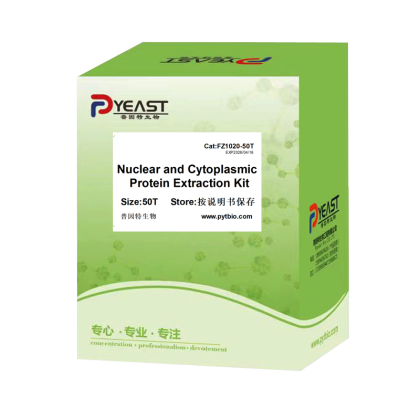
Nuclear and Cytoplasmic Protein Extraction Kit
Nuclear and Cytoplasmic Protein Extraction Kit
When studying cells, it is often necessary to examine the different components of cells, and the two most studied cell components are the nucleus and the cytoplasm. Isolating nuclear proteins and cytoplasmic proteins can be used not only to study the localization of proteins within the cell but also, in many cases, the isolated nuclear proteins can be used for research on transcriptional regulation, such as EMSA (also called gel shift), footprinting, etc. The Nuclear and Cytoplasmic Protein Extraction Kit provides a relatively simple and convenient method for extracting nuclear and cytoplasmic proteins from cultured cells or fresh tissues. It takes about 90 minutes to separate nuclear and cytoplasmic proteins from cultured cells. The extracted proteins can be used for subsequent operations such as Western blotting, EMSA, footprinting, reporter gene assays, and enzyme activity measurements. This kit uses cytoplasmic protein extraction reagents A and B under hypotonic conditions to allow cells to swell, then disrupts the cell membrane to release cytoplasmic proteins, and then centrifuges to obtain the nuclear pellet. Finally, nuclear proteins are extracted using a high-salt nuclear protein extraction reagent. For cell samples, if each sample contains no more than two million cells, the kit can process 50 samples; for tissue samples, if each sample weighs no more than 30 mg, the kit can process 50 samples; if each sample weighs about 30-60 mg, the kit can process 37 samples.
1. This product is for scientific research use only. Please do not use it for medical, clinical diagnosis or treatment, food and cosmetics, etc. Please not store it in a general residential area. 2. For your safety and health, please wear a lab coat and disposable gloves and masks when operating. 3. The experimental can be affected by a variety of factors, and the relevant treatment is limited to the product itself, and does not involve other compensation. LastProteinase KNextPMSF(100×) |