Chinese
 English
|
Service Introduction The CRISPR/Cas9/gRNA (CRISPR-Cas RNA-guided nuclease) gene knockout technology is another major breakthrough following the TALEN gene knockout technology. Compared with TALEN and ZNF technologies, the CRISPR/Cas9 system is easier to construct and use. The specificity of gene knockout is determined by gRNA rather than protein, thereby avoiding the complex plasmid assembly process and even making it possible to knock out multiple genes simultaneously. Moreover, experiments have shown that the gene knockout efficiency of the CRISPR/Cas9 system is comparable to or better than that of TALEN and ZNF. Although the specificity and some other characteristics of Cas9 still need further study, due to its extremely simple operation, this technology will greatly simplify breeding, genetic variation repair, and various gene research tasks. Service Advantages ▶Highly Experienced: We have extensive experience in yeast gene editing. Our experienced team can help you quickly complete yeast mutant construction; ▶Two Experimental Options: Scarless/Recombination; ▶Any Locus: Using our advanced Cas9 technology, mutations can be introduced at any locus; ▶Long DNA Integration: Technically optimized to allow gene knock-ins of up to 10 kb; ▶One-Stop Solution: Provides comprehensive upstream and downstream services, including yeast gene knockout and yeast complementation experiment validation; ▶Quality Assurance: All gene editing sites are verified by sequencing to ensure product quality. Service Process
Article Case An Introduced RNA-Only Approach for Plasmid Curing via the CRISPR-Cpf1 System in Saccharomyces cerevisiae academic journal:Biomolecules
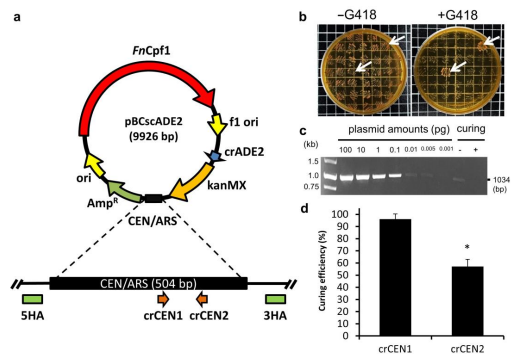
evelopment of a plasmid curing system using CRISPR-Cpf1 system in S. cerevisiae. (a) Schematic representation of the plasmid pBCscADE2, crRNAs targeting for the replication origin and the homologous DNA template of CEN/ARS sequence. (b) Plasmid-cured colonies can grow on YPD medium without G418, but not on medium containing G418. The arrows indicate the colonies which failed plasmid curing. (c) Colony PCR by primers specific for the plasmid. (d) The plasmid-curing efficiency for crCEN1 and crCEN2. Strains were transformed crCEN1 or crCEN2 with CEN HA donor DNA and plated on YPD medium with or without G418. Data were derived from three separate experiments and are presented as the means ± SD. The symbol * indicated statistically significant differences (p < 0.05 using Student’s t-test). Figure 1. Development of a plasmid curing system using CRISPR-Cpf1 system in S. cerevisiae.(a) Schematic representation of the plasmid pBCscADE2, crRNAs targeting for the replication origin and the homologous DNA template of CEN/ARS sequence. (b) Plasmid-cured colonies can grow on YPD medium without G418, but not on medium containing G418. The arrows indicate the colonies which failed plasmid curing. (c) Colony PCR by primers specific for the plasmid. (d) The plasmidcuring efficiency for crCEN1 and crCEN2. Strains were transformed crCEN1 or crCEN2 with CEN HA donor DNA and plated on YPD medium with or without G418. Data were derived from three separate experiments and are presented as the means ± SD. The symbol * indicated statistically significant differences (p < 0.05 using Student’s t-test). Applicable Fields ▶Study of protein functional mechanisms: This is a core tool for analyzing the relationship between protein structure and function. By introducing the gene of interest into relevant yeast mutants and observing changes in protein activity, binding ability, subcellular localization, and other aspects, the functional roles of the protein can be determined, revealing the molecular mechanisms by which proteins perform physiological functions. ▶Industrial biotechnology: Yeast is widely used for the sustainable production of high-value chemicals and materials. By genetically editing and metabolically engineering yeast, it can be made to produce a variety of products. ▶Optimization of industrial strain performance: Gene editing can systematically enhance the overall performance of yeast in industrial production, such as improving tolerance to increase the strain’s resistance to harsh conditions like high temperature and toxins. Additionally, optimizing metabolic pathways can yield industrial strains with stronger production capabilities. ▶Biopharmaceuticals and recombinant proteins: Expression systems represented by *Pichia pastoris* are important platforms for producing complex recombinant proteins. Gene editing technologies play a key role in this process. Construction of efficient strains: By knocking out specific genes (such as KU70, pep4), the stability and yield of exogenous proteins can be improved. Optimization of expression systems: Using technologies like CRISPR to build inducible expression systems allows for safer and more efficient protein production. |