Chinese
 English
|
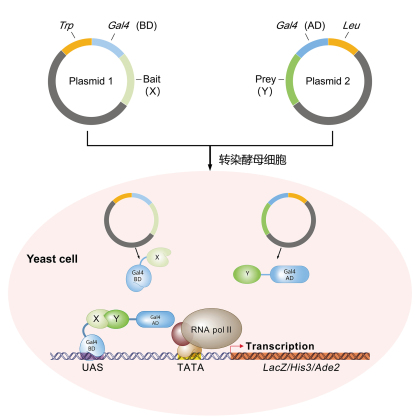
Service Introduction The yeast two-hybrid system is a research method for identifying and detecting protein-protein interactions. Due to its high sensitivity, powerful functionality, and wide applicability, it has now been applied in multiple research fields. Nuclear system yeast two-hybrid: The yeast two-hybrid system was originally established by Fields and others while studying the properties of the yeast transcription factor GAL4. With continuous improvements over time, it has developed into a mature tool for studying protein-protein interactions. It is convenient, sensitive, and capable of reflecting the true interactions of proteins within living cells. It is widely used for screening interacting proteins, identifying/validating protein interactions, exploring mechanisms of protein interactions, and mapping protein interaction networks. Membrane yeast two-hybrid: DUALmembrane technology, based on the traditional yeast two-hybrid system, cleverly utilizes a split-ubiquitin system to screen for protein-protein interactions; ubiquitin, as a degradation signal molecule, is artificially divided into two parts: the N-terminal (Nub) and the C-terminal (Cub). The reconstituted complete ubiquitin molecule can be recognized by ubiquitin-specific proteases (UBPs), leading to the degradation of proteins linked to ubiquitin. DUALhunter Yeast Two-Hybrid: The DUALhunter system is based on the DUALmembrane system technology with appropriate modifications. It anchors non-membrane proteins to the cell membrane by using the Ost1 membrane anchor structure to attach bait proteins. This system is suitable for plasma proteins, membrane proteins, organelle proteins, and auto-activating proteins. The introduction of this technology has greatly expanded the application scope of yeast two-hybrid systems. Service Advantages ▶Many years of experience in library construction, effectively ensuring library quality; ▶Three-frame normalization technology, effectively ensuring correct gene translation and uniform gene coverage in the library; ▶One-stop assisted bioinformatics analysis, providing reliable experimental conclusions; ▶Directly detect interactions between proteins without relying on other molecules or cellular participation; ▶Capable of simultaneously screening and identifying interactions among multiple proteins, enabling high-throughput screening and analysis; ▶Multiple screening steps, such as reporter gene verification and dual selection of yeast strains, can reduce false positives from non-specific interactions;; ▶The expression level of reporter genes can be used to quantitatively evaluate the strength of protein interactions, further understanding the dynamics and function of the interactions. Service Process Yeast Two-Hybrid Library Construction
Yeast two-hybrid library screening
Yeast two-hybrid validation
Article Case (1) Nuclear system yeast two-hybrid Tuber mustard BjuFIP gene negatively regulates plant sensitivity to abscisic acid academic journal:Scientific Reports
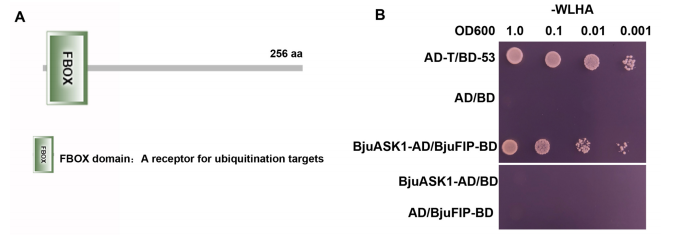
Protein motif analysis of BjuFIP and the interaction analysis of BjuFIP with 3 BjuASK1 in Y-2-H and BiFC assays.4 (A) Protein motif analysis of BjuFIP. FBOX domain: a receptor for ubiquitination targets. 5 (B) The F-box protein BjuFIP was found to interact with BjuASK1 by Y-2-H growth 6 assay performed on SD media lacking Leu and Trp (-WL) and Ade, His, Leu, and Trp 7 (-WLHA). Saturated cultures were spotted onto SD media lacking Ade, His, Leu, and 8 Trp (-WLHA) at different dilutions (OD600=1, 0.1, 0.01, and 0.001). The vectors AD-T 9 and BD-53 were used as positive controls and the emptyvectors AD and BD were used 10 as negative controls. (2) Membrane system yeast two-hybrid A Bacterial-Type ABC Transporter Is Involved in Aluminum Tolerance in Rice academic journal:The Plant Cell
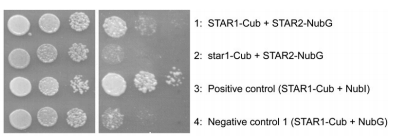
DUALmembrane system. STAR1 and STAR2 were fused to the C-terminal half (Cub) and the mutated N-terminal half (NubG) of ubiquitin,respectively. Yeast cells were cotransformed with various plasmid combinations as indicated at the right and were grown on SD medium without Leu and Trp as a control (left panel) or on a selective medium for protein interaction (right panel) without Leu, Trp, His, and Ade and containing 10 mM 3-aminotriazole at different concentrations (10 times dilution from left side). All plates were grown for 3 d at 30℃. (3) DUALhunter system yeast two-hybrid An Arabidopsis Dual-Localized Pentatricopeptide Repeat Protein Interacts with Nuclear Proteins Involved in Gene Expression Regulation academic journal:The Plant Cell
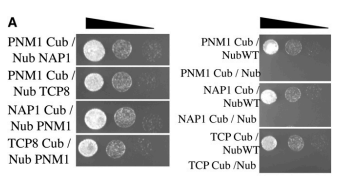
Yeast two-hybrid–like assays show that PNM1 interacts with NAP1 and TCP8. Yeast cells were cotransformed with X-Cub and Nub-X constructs. Liquid cultures of double transformants are plated at DO600 = 0.1 and at increasing 103 and 1003 dilutions of the cultures (black triangles) on synthetic dropout selective medium that lacked Leu, His, adenine and Trp supplemented with 10 mM 3-amino-1,2,4-triazole. NubWT represents the nonmutated form of the N-terminal part of ubiquitin and was used here as a positive control for interactions with Cub constructs. Applicable Fields ▶Protein-protein interaction research: The yeast two-hybrid technique is widely used to study interaction networks between proteins. By identifying and validating interactions between proteins, it is possible to reveal the composition and structure of protein complexes, thereby gaining deeper insight into biological processes such as cellular signal transduction, transcriptional regulation, and metabolic pathways. ▶Protein function research: Using the yeast two-hybrid technique, the function and regulatory mechanisms of proteins can be studied. For example, by identifying interactions between proteins and transcription factors, nucleic acid-binding proteins, and others, one can understand the role of proteins in gene regulation as well as the establishment and maintenance of regulatory networks. ▶Evolutionary biology research: The yeast two-hybrid technique can be used to study protein interactions across species. By comparing interaction networks in different species, one can understand the evolutionary changes in protein interactions and explore the basis of species adaptation and evolution. |