Chinese
 English
|
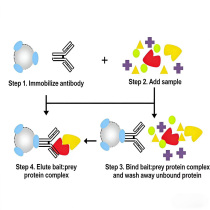
Service introduction Co-immunoprecipitation (Co-IP) is a classic method for studying protein-protein interactions based on the specific immune reaction between antibodies and antigens. Its basic principle involves adding antigen-specific antibodies to cell lysates. The antibodies, antigens, and proteins interacting with the antigens form immune complexes through an immunoprecipitation reaction. After purification, elution, and collection of the immune complexes, SDS-PAGE electrophoresis, Western blotting, and/or mass spectrometry can identify the proteins interacting with the antigen. Service advantages ▶In the plant science field, clients don't need to create transgenic plants; Protech can rapidly obtain experimental materials that would otherwise require extensive preparation through protoplast co-transformation; ▶It directly detects protein-protein interactions, providing both qualitative and quantitative information; ▶It can be performed under native conditions, more closely resembling the intracellular environment, which helps reveal interactions within organisms; ▶It can study complex protein complexes, including those with multiple subunits or larger protein complexes; ▶Validation and functional studies can further validate the biological functions of these interactions. Service Process
Article Case Decoding VaCOLD1 Function in Grapevines: A Membrane Protein Enhancing Cold Stress Tolerance academic journal:Journal of Agricultural and Food Chemistry
Co-IP assays showed that Myc-VaCOLD1 coprecipitated with VaGPA1-Flag. Applicable Fields ▶Revealing the composition and function of protein complexes: Co-IP technology can be used to identify the composition and structure of protein complexes. By selecting a specific target protein as the antibody target, it can be co-precipitated with other interacting proteins, thereby determining the composition of the protein complex. This helps to understand the functions of protein complexes within cells, their interaction networks, and signaling pathways. ▶Studying signal transduction and gene regulation: Co-IP technology can be used to study protein interactions involved in signal transduction and gene regulation. For example, co-precipitation experiments can determine the binding of transcription factors to DNA sequences and reveal the mechanisms of gene regulation. In addition, Co-IP can also be used to study interactions between protein kinases and their substrates, thereby understanding the regulatory mechanisms of cellular signaling pathways. |