Chinese
 English
|
|
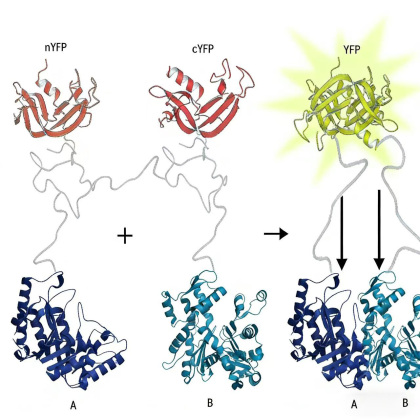
Service Introduction The fluorescent protein is split at specific sites to form two non-fluorescent polypeptides, the N-terminal and C-terminal fragments, referred to as the N-fragment and C-fragment. When these two fragments are co-expressed in cells or mixed in vitro, they cannot spontaneously assemble into a complete fluorescent protein and do not produce fluorescence when excited by the fluorescent protein's excitation light. However, when these two fragments of the fluorescent protein are each fused to a pair of interacting target proteins and the two fusion proteins are co-expressed in tobacco leaf cells, the interaction between the target proteins brings the two fragments of the fluorescent protein into close spatial proximity, complementing each other, and reconstructing a functional fluorescent protein. Under excitation light, this reconstituted fluorescent protein emits fluorescence. In short, if there is an interaction between the target proteins, fluorescence of the fluorescent protein is produced upon excitation. Conversely, if there is no interaction between the proteins, no fluorescence is generated upon excitation. Service Advantages ▶High specificity: The fluorescent signal only appears when the target proteins interact, reducing false positive results and increasing the specificity of detection. ▶Detection of weak or transient interactions: Sensitive to low-affinity and short-lived interactions, capable of revealing some interactions that are difficult to detect with traditional methods. Service Process
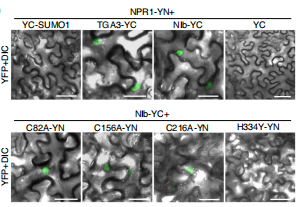
Article Case A plant RNA virus inhibits NPR1 sumoylation and subverts NPR1-mediated plant immunity academic journal:nature communications
Confocal microscopic photographs of N. benthamiana epidermal cells that were infiltrated by agrobacteria harboring the indicated plasmids at 2 dpi. Scalebar, 50 μm. The experiment was independently repeated three times with similar results. c. Applicable Fields ▶Protein interaction network research: Revealing direct interactions between proteins in complex signaling pathways. ▶Drug screening and validation: Detecting the effects of candidate drugs on specific protein interactions and evaluating their biological activity. ▶Plant science: Studying key protein interactions in processes such as plant growth and development, stress responses, and signal transduction. |