Chinese
 English
|
|
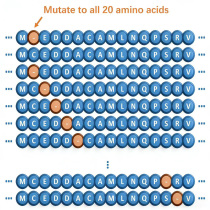
Service Introduction Site-saturation mutagenesis is an emerging technique in protein engineering. It involves modifying the gene encoding a target protein to quickly generate mutants in which specific amino acid residues are each replaced by the other 19 amino acids. This technique is not only a powerful tool for directed protein modification but also an important method for studying protein structure-function relationships. Saturation mutagenesis can be performed at sites related to a particular protein function chosen by the client, and the desired protein can then be obtained through screening, followed by determination of its gene sequence. Service Advantages ▶Experimental Design: Designed and optimized experimental plans by Puinte make your experimental results more precise. Library Capacity: Up to 10¹²; ▶Extremely high mutation accuracy: the highest mutation rate in the mutated regions and the lowest error rate in the non-mutated regions (overall accuracy >75%); ▶Fast and high-quality service with professional technical support: We provide full assistance to resolve any technical or service-related questions. Comprehensive project management: Keep your project information updated regularly and track your project progress promptly. Service Process
Article Case Molecular Determinants of Mutant Phenotypes, Inferred from Saturation Mutagenesis Data academic journal:Molecular Determinants of Mutant Phenotypes
Mutational effects on CcdB protein activity inferred from phenotypic screening and deep sequencing. (A), (B) and (C) show the MSseq values for representative exposed-site (accessibility >5%), all active-site and buried-site residues (accessibility 5%), respectively. On the vertical axis,residues are grouped into (G, P), aliphatic (A–M), aromatic (F–W), polar (S–Q) and charged (D–R) amino acids. Residue numbers and substitutions are indicated on the horizontal and vertical axes, respectively. Each heatmap is colored according to the MSseq value of the mutant. Green to red color gradation represents increasing MSseq values. Zero value (light green) indicates that the corresponding mutant was not observed in the library. WT residue at each position is indicated in white. Data for only representative residue positions are shown for clarity. (D) Active-site residues (highlighted in cyan) identified from the mutational phenotypes mapped onto the crystal structure of CcdB (PDB ID 3VUB). Applicable Fields ▶Enhance protein activity; ▶Modification of industrial enzymes; ▶Antibody affinity mutations and humanization of antibodies; ▶Extend the blood half-life of therapeutic proteins; ▶Improve biochemical properties of proteins (such as solubility, thermal stability, substrate binding specificity); ▶Applications in agricultural science, petrochemicals, bioengineering, cancer research, and gene expression and regulation. |