Chinese
 English
|
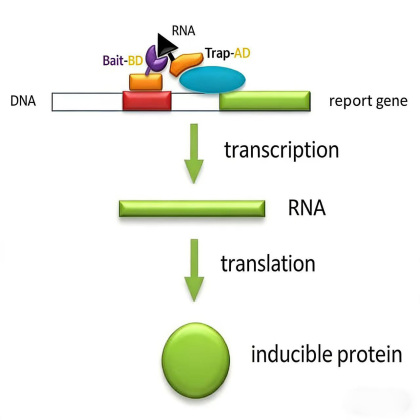
Service Introduction The yeast three-hybrid system can be used to analyze interactions between proteins and RNA. In the yeast three-hybrid system, RNA-protein interactions lead to the transcription of a reporter gene, and the interaction between proteins and RNA can be detected through cell growth, colony color, or specific enzyme activity. The YBZ-1 strain used in this kit is based on the L40 Coat strain, with some structural modifications made to the MS2 coat protein, such as mutating the 55th amino acid from N to K, and connecting two MS2 coat protein sequences of MS2(N55K) through a 9-amino-acid linker, in order to increase the affinity between RNA and protein and improve screening efficiency. Service Advantages ▶Technologically targeted and precise, focusing on core research needs; ▶Customized YBZ-1 strains, significantly improving screening efficiency; ▶Multi-dimensional detection system, with reliable and verifiable results; ▶Can be integrated with our interactive experiments, allowing the entire process to be completed smoothly and quickly. Service Process
Article Case Expanding the binding specificity for RNA recognition by a PUF domain academic journal:nature communications
Yeast three-hybrid assays show the binding of the wild-type PUF domain andQFR/VFQ variant. The negative control is a wild-type PUF domain that has stop codons in the TRM locations (repeat 1) paired with wild-type RNA. SC-L,synthetic complete media minus leucine; SC-L-H, synthetic complete media minus leucine and histidine. C Spot dilution plate assay indicates the binding of the design 1 and design 2 PUF domains to their target RNAs. The negative control is as in (B). The starting OD600 that was spotted was 0.05, with three sequential 10-fold serial dilutions shown. Applicable Fields ▶Yeast three-hybrid system: This is its most classic application. It is used to screen proteins that interact with known RNA, or to verify the specific binding between RNA and proteins. For example, by constructing an RNA bait containing MS2 stem-loops and co-transfecting it with proteins from a cDNA library that carry an activation domain into yeast strains containing LexA-MS2, positive interaction pairs can be screened through reporter gene phenotypes. ▶RNA localization and transcriptional regulation studies: Specific RNA can be targeted to particular genomic DNA sites (such as regions containing lexAop) to study the regulatory functions of RNA at the chromatin level, or to construct RNA-based transcriptional activation/inhibition systems. ▶In vitro validation of RNA-protein interactions: Purified LexA-MS2 fusion proteins can be used in in vitro pull-down experiments to enrich protein complexes that bind MS2 stem-loop-tagged RNA, aiding subsequent analyses such as mass spectrometry identification. |