Chinese
 English
|
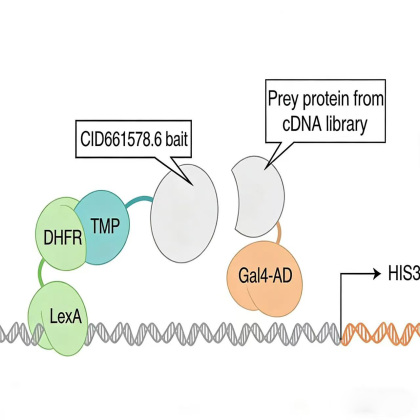
Service Introduction YChemH - small molecule three-hybrid system is a small molecule chemical analysis technique derived from the established yeast two-hybrid (Y2H) technology, used as a methodological approach for drug target screening and identification. It uses the small molecule or drug of interest as bait to screen highly complex protein domain libraries prepared from any type of cell, tissue, or organism. Since an active transcription factor is reconstituted from the DNA-binding domain (DBD) and activation domain (AD) components, it can be used to identify drug-protein interactions. The small molecule three-hybrid system originally arose from the use of cell-permeable polymeric small molecule chemical inducers (CIDs) to promote oligomerization of chimeric receptors in mammalian cells. When the “drug-target protein” interaction occurs, the tagged drug bridges the gap between DBD and AD due to the tag-ABD interaction. This enables the expression of reporter genes and the growth of yeast on selective media, allowing for positive clones to be analyzed by sequencing to identify the target protein. Service Advantages ▶Directly verify interactions in live yeast cells. This maintains the physiological environment of protein folding and post-translational modifications in eukaryotic cells, avoiding conformational changes or functional inactivation caused by in vitro purified proteins, thereby detecting interactions closer to the true physiological state; ▶The service does not require pre-purification of target proteins, but instead screens the entire cellular proteome by introducing a cDNA library into yeast. This means that even low-abundance proteins have a chance to be identified; ▶Experimental results are reliable and visually appealing; ▶Mainly relies on basic yeast culture and molecular biology equipment, and for academic laboratories, the technical threshold and resource consumption are generally lower than chemical proteomics methods that require large mass spectrometry instruments. Service Process
Article Case MNK2 deficiency potentiates β-cell regeneration via translational regulation academic journal:NATURE CHEMICAl BIOLOGY
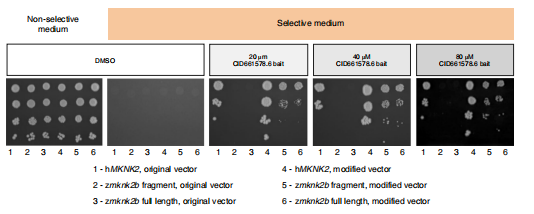
Validation of the zebrafish Mnk2b–CID661578.6 interaction with different concentrations of CID661578.6 bait and two different DHFR hook vectors. Experiments using the original hook vector, N-LexA–DHFR-C, are listed as 1, 2 and 3. Experiments using the modified vector with the reverse order, N-DHFR–LexA-C, are listed as 4, 5 and 6. Both full-length zebrafish Mnk2b (3 and 6) and a fragment (2 and 4) corresponding to the original fragment of the human MNK2 identified in the screen were used. Human MNK2 was used as a positive control (1 and 4), and zebrafish Mnk2b only mediated binding when expressed by the hook vector with the reverse order (5 and 6) to the one used in the original screen (explaining why zebrafish Mnk2b did not show up as a hit in the original screen). Applicable Fields ▶Detect interactions between compounds and proteins; ▶Drug target validation and secondary confirmation; ▶Verify specific interactions between compounds and target proteins; ▶Verify compound regulation of protein-protein interactions. |