Chinese
 English
|
|
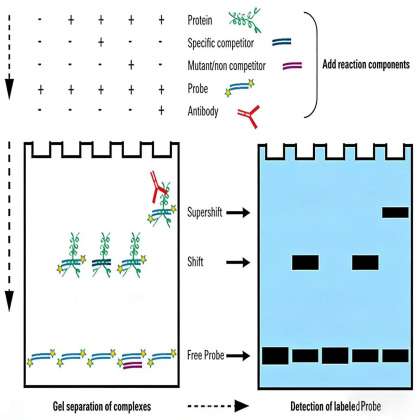
Service Introduction Gel shift or electrophoretic mobility shift assay (EMSA) is a technique used to detect the interaction between proteins and DNA sequences, and it can be applied for both qualitative and quantitative analysis. It is currently used to study the interaction between RNA-binding proteins and specific RNA sequences, and it is a classic method for research on transcription factors. Verification EMSA Used to verify whether the probe contains a site that can bind to the protein. By mutating the binding site and using the mutated probe as a control, if a shift band appears with the wild-type probe but not with the mutated probe, it indicates that the probe contains a site capable of binding to the protein. Competitive EMSA The probe sequence remains unchanged; a probe without any modifications is called a cold probe. The cold probe competes with the labeled probe for protein binding, and the cold probe does not display a shift band. Using the cold probe as a control, if the labeled probe shows a shift band while the shift band of the cold probe is weakened or disappears, it rules out false-positive interference and increases the accuracy of the experimental results. Supershift EMSAA Using a specific antibody for the target protein, the protein-probe complex is recognized and bound by the antibody. This trimeric complex migrates more slowly in gel electrophoresis, appearing as a supershift band above the protein-probe complex, confirming the specific binding between the probe and the target protein. Service Advantages ▶One-stop service: Covers the entire process from gene design and protein expression and purification to functional validation; ▶High success rate guarantee: Strict quality control system (SDS-PAGE, Western Blot, etc.); ▶High flexibility: Supports optimization of various expression conditions (temperature, induction time, etc.); ▶Professional team: Provides value-added services such as codon optimization, vector construction, and probe design; ▶Reliable data: Experimental reports include raw data, charts, and detailed analysis. Service Process
Article Case Sclerenchyma cell thickening through enhanced lignification induced by OsMYB30 prevents fungal penetration of rice leaves academic journal:New Phytologist
Direct binding of OsMYB30 to the Os4CL3promoter. The probe was labelled with biotin at the 5 end. Wild-type (GATCAATCGC CGCCGCCGTC TCCTCG), mutant competitor-M8 (GATCAATAAAAAAAACCGTC TCCTCG), or mutant competitor-M3 (GATCAATCGC CGCCGCCAAA AAAAAG) oligonucleotides were used for competitive binding in 10-,and 50-fold excess of the wild-type probe. (e) Binding of OsMYB30 to the Os4CL5 promoter in EMSA. The probe was labelled with biotin at the 50 end.Wild-type (TCGCCGCCGCCGCCGCTGTCGCCGTCG), mutant competitor-1 (TCGCCGCAAA AAAAACTGTCGCCGTCG), or mutant competitor-2(TCGCCGCCGCCGCCGCTAAA AAAAACG) oligonucleotides were used for competitive binding in 10-, and 50-fold excess of the wild-type probe. Applicable Fields ▶Used to study the interactions between DNA-binding proteins and specific DNA sequences. ▶Used to study the interactions between RNA-binding proteins and specific RNA sequences. |