Chinese
 English
|
Service Introduction The RUBY protein interaction system is a tool developed based on the yeast two-hybrid system for studying nucleic acid-protein interactions. It uses the principle of yeast two-hybrid to detect protein-protein interactions in living plants through a visual reporter system. Its design is very ingenious, directly converting protein interactions into visible color changes. Service Advantages ▶Intuitive visualization of results: No complex instruments are required; observations and judgments can be made with the naked eye or a regular camera. ▶Simple operation and low cost: Uses the widely present "tyrosine" in plants as a substrate, without the need for any expensive exogenous substrates or chemical reagents. ▶In vivo and in situ detection: Can be performed on intact live plants (such as Nicotiana benthamiana leaves), accurately reflecting cellular interactions and avoiding artifacts caused by sample processing. ▶Suitable for quantitative analysis: After extracting the red pigment (betalain), absorbance can be measured with a spectrophotometer for semi-quantitative analysis of interaction strength. Service Process
Article Case A split GAL4 RUBY assay for visual in planta detection of protein–protein interactions academic journal:The Plant Journal
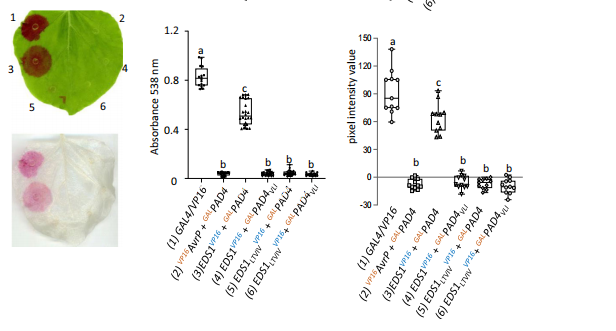
Interaction between N. benthamiana PAD4 and EDS1 proteins. UAS-RUBY containing Agrobacteria were co-infiltrated into N. benthamiana leaves with cultures containing: (1) GAL/VP16, (2) VP16/AvrP and GAL/NbPAD4 (negative control), (3) NbEDS1/VP16 and GAL/NbPAD4, (4) NbEDS1/VP16 and GAL/NbPAD4VLI,(5) NbEDS1LTVIV/VP16 and GAL/NbPAD4, (6) NbEDS1LTVIV/VP16 and GAL/NbPAD4VLI. Betalain was quantified 5 dpi spectrophotometrically (graph in middle) andby pixel intensity quantification (right-hand graph). Columns 1–6 on both graphs are the same samples and correspond to infiltration sites 1–6 on the leafshown. Common letters above graph boxes indicate no significant (P > 0.05; one-way ANOVA with post hoc Tukey HSD) differences between samples. Applicable Fields ▶Verify known protein interactions: Intuitively confirm whether two proteins interact within the plant. ▶Screen interacting proteins: Can be used to identify unknown proteins (“prey”) that interact with a target protein (“bait”). ▶Study plant-pathogen interactions: Especially suitable for investigating the direct interactions between plant resistance proteins (R proteins) and pathogen effector proteins, which is crucial for understanding disease resistance mechanisms. |