Chinese
 English
|
|
Service Introduction Transcription factors can be divided into transcription activators and transcription repressors according to their functions. Transcription activators can promote gene transcription, while transcription repressors can inhibit gene transcription. Transcription factors can affect gene transcription in various ways. Among them, transcription activators can form complexes with RNA polymerase and other regulatory factors, bind to DNA, and change its chromatin state, making RNA polymerase more accessible to the gene promoter region, thereby promoting gene transcription. Some transcription factors can inhibit gene transcription by recruiting transcription repressors. Yeast Detection System: A standalone BD can bind to the upstream activating sequence (UAS) of GAL4 but cannot initiate transcription. However, if a transcription factor with transcriptional activation activity is constructed into the BD vector, the expressed bait protein can bind to the UAS alone and trigger the transcription and expression of the downstream reporter gene. By assessing the transcription and expression of the downstream reporter gene, we can determine whether the transcription factor has transcriptional activation activity. Dual-Luciferase Reporter Gene Detection System: The transcription factor to be tested is constructed on the same vector with the GAL4 binding domain and co-transfected with an expression vector containing the GAL-TATA transcription regulatory element along with Firefly luciferase. This sequence controls the transcription and expression of luciferase. Then the reporter gene plasmid is transfected into cells, the cells are cultured and lysed, and the substrate luciferin is added. Luciferase catalyzes luciferin to emit light. By measuring the fluorescence intensity, it is possible to determine whether the transcription factor has transcriptional activation or transcriptional repression activity. Service Advantages ▶The experimental results are reliable, and the images are visually appealing; ▶In addition to transcription activation detection experiments, services such as yeast two-hybrid interaction and library screening can also be provided, which can further enrich the experimental content. Service Process Yeast Detection System
Dual Luciferase Reporter Gene Assay System
Article Case (1) Yeast Detection System Natural variation of OsWRKY23 drives difference in nitrate use efficiency between indica and japonica rice academic journal:nature communications
OsWRKY23 showed transactivation activity in yeast. Full-length, N-terminal deletion, and C-terminal deletion cDNAs of OsWRKY23 were cloned into pGBKT7 and fused with the GAL4 DNA-binding domain. Numbers indicate the positions of the amino acid of OsWRKY23. (2) Dual Luciferase Reporter Gene Assay System Plant NAC-type transcription factor proteins contain a NARD domain for repression of transcriptional activation academic journal:Planta
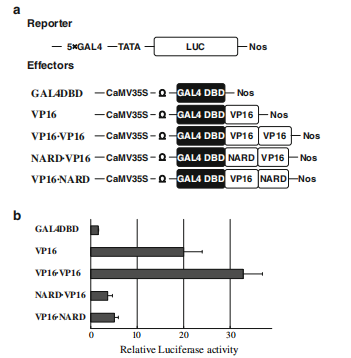
EVect of NARD on VP16 activity in protoplast assay. a Schematic representation of constructs used in Arabidopsis transient assay. The reporter construct GAL4-LUC contained Wve copies of the GAL4 responsive element, minimal TATA box region (starting at position ¡46) of 35S promoter, the WreXy gene for luciferase (LUC; shown as a closed box), and a nopaline synthase (Nos) terminator. Each of the eVectors contained a GAL4 DNA-binding domain (GAL4DBD). GALDBD was also used as a negative control. The GAL4DBD was fused with VP16 (VP16), or with two copies of VP16 (VP16 VP16) and used as positive controls. NARD was fused to the N-terminal or C-terminal of VP16 to test its eVects. All the constructs were driven by 35S promoter with translation enhancer sequence, and ended by Nos terminal. b NARD inhibits the VP16 activity. Relative luciferase activity was measured after PEG co-transfection of protoplasts with GAL4-LUC reporter and GAL4 fusion eVector plasmids. Luciferase activity was examined when the transformed protoplasts were cultured for 6 h. Applicable Fields ▶The effect of transcription factors on downstream genes. ▶Verification of transcription factor activity. |