Chinese
 English
|
|
Service Introduction EY917 is a genetically engineered yeast strain used for studying the function of plant phosphate transport proteins. Its key feature is that multiple endogenous phosphate transporter genes in the genome (such as pho84, pho87, pho89, pho90, and pho91) have been deleted, rendering it unable to absorb phosphate ions and making it a phosphate transport-defective strain. To ensure the strain survives during experimental operations, EY917 also contains a GAL1 promoter induced by galactose and carries a plasmid expressing the yeast's own PHO84 transporter gene. Therefore, when culturing and amplifying this strain, it needs to be grown in a medium with galactose as the carbon source. R196 is a high-efficiency yeast protein expression vector with Ura3 as the selection marker. When a gene X encoding a phosphate transporter protein is constructed into the pDR196 vector (pDR196-X) and transformed into EY917 competent cells, the X protein will mediate phosphate absorption in the yeast cells, enabling EY917 to grow normally in a phosphate-containing medium. Service Advantages ▶Can detect whether a protein has phosphate ion uptake and transport activity, simple and efficient. ▶Our company has all the reagents, strains, and vectors needed for detecting phosphate ion transport activity. Service Process
Article Case Expressing Phosphate Transporter PvPht2;1 Enhances P Transport to the Chloroplasts and Increases Arsenic Tolerance in Arabidopsis Thaliana academic journal:Environmental Science & Technology
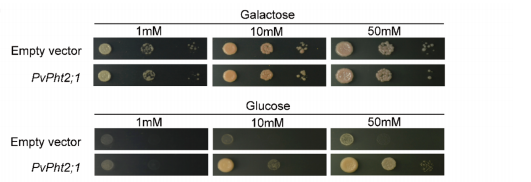
P and As transport activity of PvPht2;1 in a yeast mutant. (a) Complementation of PvPht2;1 in yeast mutant EY917 defective in P uptake under different P concentrations (1−50 mM P). (b,c) Growth curves of yeast cells expressing PvPht1;3. Applicable Fields ▶Functional Identification of Phosphate Transport Proteins: Identify the in vivo transport functions of candidate phosphate transporter genes from plants, microorganisms, and animals, and determine whether the target genes possess the core activity required for mediating phosphate ion transmembrane uptake. This is a key technical approach for gene function validation. ▶Plant Stress Physiology Research: Analyze the role of phosphate transport proteins in maintaining intracellular phosphate ion homeostasis in crops under stress conditions such as phosphate deficiency or heavy metal stress; screen for crop genes that are tolerant to low phosphate or efficient in phosphate utilization, providing targets for breeding nutrient-efficient crops. ▶Microbial Phosphate Metabolism Mechanism Analysis: Study the phosphate transport systems of microorganisms such as bacteria and fungi, and clarify the regulatory mechanisms of phosphate transport proteins in microbial adaptation to phosphate-deficient environments and maintenance of enzyme activity (e.g., superoxide dismutase). ▶Functional Screening of Phosphate Transport Protein Mutants/Variants: Perform functional validation of different mutants and allelic variants of phosphate transport proteins, evaluate the impact of amino acid site mutations on transport activity, and support research on protein structure-function relationships. |