Chinese
 English
|
|
Service Introduction Specifically designed for the study of yeast manganese metabolism and transporter protein function, based on the principle of heterologous complementation experiments in yeast. It includes a specialized manganese-deficient yeast strain and expression vectors. The manganese-deficient strain, due to the absence of endogenous transporter proteins, exhibits inhibited growth in low-manganese environments. After the target transporter protein gene is transformed into the strain, if the protein is active, it can complement the defective phenotype, directly reflecting transport ability while excluding interference from other cations. This system is suitable for transporter protein function verification, manganese metabolism gene screening, and regulatory mechanism studies. The △smf strain is derived from the BY4741 yeast strain and lacks the endogenous gene △smf, which has a high affinity for manganese ions, significantly reducing manganese uptake and transport capability. △smf is commonly used in manganese ion transporter identification tests; it grows normally on basic media but shows poor growth on media containing high concentrations of the divalent cation chelator EGTA. pDR196 is a high-efficiency protein expression vector for Saccharomyces cerevisiae, with Ura3 as the selection marker. When the gene X encoding a manganese transporter protein is constructed into the pDR196 vector and transformed into △smf competent cells, protein X mediates manganese uptake in the yeast cells, allowing △smf yeast to grow normally in manganese-deficient media. Service Advantages ▶Can detect whether a protein has manganese ion uptake and transport activity, simple and efficient. ▶Our company has all the reagents, strains, and vectors needed for manganese ion transport activity detection. Service Process
Article Case Cadmium and iron transport by members of a plant metal transporter family in Arabidopsis with homology to Nramp genes academic journal:PLANT BIOLOGY
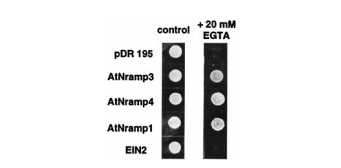
AtNramp genes complement a yeast mutant deficient in Mn uptake.Growth of smf1 yeast cells expressing AtNramp1, AtNramp3, or AtNramp4 on SD plates supplemented (Right) or not (Left) with 20 mM EGTA.smf1 yeast cells were transformed either with empty pDR195 or with pDR195 containing the cDNAs of AtNramp1, AtNramp3, AtNramp4 or of EIN2. Transformed strains were grown overnight in liquid synthetic dextrose-ura. The cultures were diluted to an OD of 0.1 and spotted on plates containing synthetic dextrose ura (pH 6). The plates were incubated at 30°C for 3 days before photography. Applicable Fields ▶Functional identification of manganese transport proteins: Determine the in vivo transport function of candidate manganese transporter genes from plants, microorganisms, and animals, and clarify whether the target gene possesses the core activity to mediate manganese ion transmembrane uptake. This is a key technical approach for gene function validation. ▶Plant stress physiology research: Analyze the role of manganese transport proteins in maintaining intracellular manganese homeostasis in crops under stresses such as manganese deficiency and heavy metal stress; screen for crops with low manganese tolerance or high manganese utilization efficiency, providing targets for nutrient-efficient breeding. ▶Microbial manganese metabolism mechanism analysis: Study the manganese transport systems of bacteria, fungi, and other microorganisms, and clarify the regulatory mechanisms by which manganese transport proteins help microorganisms adapt to manganese-deficient environments and maintain enzyme activity (e.g., manganese superoxide dismutase). ▶Functional screening of manganese transporter mutants/variants: Conduct functional verification of different mutants and allelic variants of manganese transport proteins, assess the impact of amino acid site mutations on transport activity, and support the study of protein structure-function relationships. |