Chinese
 English
|
|
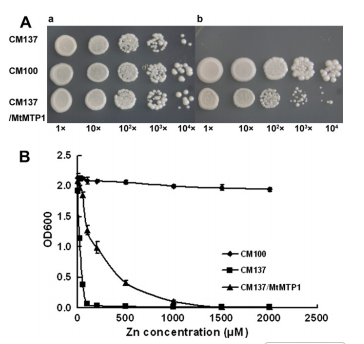
Service Introduction The yeast zinc ion transport activity detection kit is used to determine whether a protein has zinc ion transport activity. It usually employs the △zrc1 cot1 Saccharomyces cerevisiae strain. The △zrc1 cot1 Saccharomyces cerevisiae strain is a Zn2+/zinc ion-deficient strain, lacking△zrc1 and cot1, and it has lost the ability to transport Zn2+. The △zrc1 cot1 strain is often used in experiments to identify Zn2+ transport proteins. This strain is particularly sensitive to Zn2+ and its growth is significantly inhibited on media containing 1000 μM ZnCl2. Service Advantages ▶Can detect whether a protein has zinc ion uptake and transport activity, simple and efficient. ▶Our company has all the reagents, strains, and vectors needed for zinc ion transport activity detection. Service Process
Article Case Identification and characterization of MtMTP1, a Zn transporter of CDF family,in the Medicago truncatula academic journal:Plant Physiology and Biochemistry
Zn resistance of the yeast zrc1 cot1 double mutant expressing MtMTP1. A, The yeast zrc1 cot1 double mutant CM137 was transformed with pYES2-MtMTP1. CM137 is a negative control, and CM100 (wild-type) is a positive control. Serially diluted yeast cultures were spotted on SC (2% galactose-ura) plates with 500 mM ZnCl2 (b) or no ZnCl2 (a). Plates were incubated for 3 days at 30 C. B, Zinc tolerance of yeast cells in liquid culture. CM137 transformed with MtMTP1 (triangles) or empty vector (squares), and CM100 (diamonds) were incubated in liquid SC (2% galactose-ura) medium supplemented with indicated concentration of ZnCl2. The density of culture was measured after culturing for 24 h at 30 C with shaking at 150 rpm. The OD600 of the initial density of cell cultures was 0.01. Applicable Fields ▶Functional identification of zinc transporters: Determine the in vivo transport function of candidate zinc transporter genes from plants, microorganisms, and animals, and clarify whether the target gene possesses the core activity to mediate transmembrane zinc ion uptake. This is a key technical approach for gene function validation. ▶Plant stress physiology research: Analyze the role of zinc transporters in maintaining intracellular zinc homeostasis in crops under stresses such as zinc deficiency and heavy metal exposure; screen for genes in crops that are tolerant to low zinc or utilize zinc efficiently, providing targets for nutrient-efficient breeding. ▶Microbial zinc metabolism mechanism analysis: Study the zinc transport systems in bacteria, fungi, and other microorganisms to clarify the regulatory mechanisms by which zinc transporters help microbes adapt to zinc-deficient environments and maintain enzyme activity (e.g., zinc superoxide dismutase). ▶Functional screening of zinc transporter mutants/variants: Perform functional validation on different mutants and allelic variants of zinc transporters, assess the impact of amino acid site mutations on transport activity, and contribute to the study of protein structure-function relationships. |