Chinese
 English
|
|
Service Introduction Specifically designed for the study of yeast potassium metabolism and transport protein function, based on the principle of heterologous complementation in yeast. It includes a specialized potassium-deficient yeast strain, high-efficiency expression vectors, and supporting reagents. The deficient strain, due to the deletion of endogenous potassium transport genes, exhibits growth inhibition in low-potassium environments. After transforming the strain with the target transport protein gene, an active protein can complement the deficiency phenotype, directly reflecting the potassium ion transport ability and eliminating interference from other cations. It is suitable for transport protein function verification, screening of potassium metabolism-related genes, and research on regulatory mechanisms. The R5421 Saccharomyces cerevisiae strain is a K+/potassium ion-deficient strain, with its two endogenous potassium transport genes (TRK1 and TRK2) mutated. It is also referred to as CY162 in the literature and is mainly used in K+/potassium transport protein identification assays, but it can also be used for identifying K+/potassium channels or sodium-potassium pumps. Transformation markers: Ura3, Leu2. This strain can grow normally on medium containing 100 mM KCl, grows slowly on medium containing 5-10 mM KCl, and ceases growth when the KCl concentration in the medium is below 0.5 mM. pYES2 is a high-efficiency yeast protein expression vector with a Ura3 selection marker. The GAL1 promoter requires galactose induction for protein expression. By constructing the K+ transport protein gene X into the pYES2 vector (pYES2-X) and transforming it into R5421 competent cells, the X protein mediates yeast potassium uptake from the medium, enabling R5421 yeast to grow normally on low-potassium AP medium. Service Advantages ▶Can detect whether the protein has potassium ion uptake transport activity, simple and efficient. ▶Our company has all the reagents, strains, and vectors needed for detecting potassium ion transport activity. Service Process
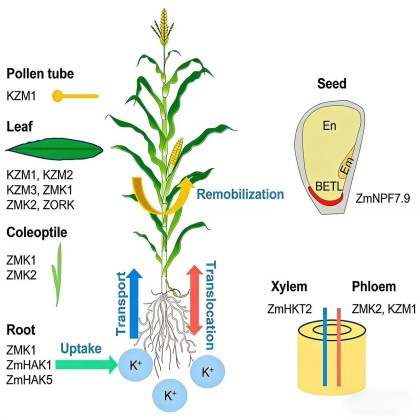
Article Case ZmHAK5 and ZmHAK1 function in K+ uptake and distribution in maize under low K+ conditions academic journal:Journal of Integrative Plant Biology
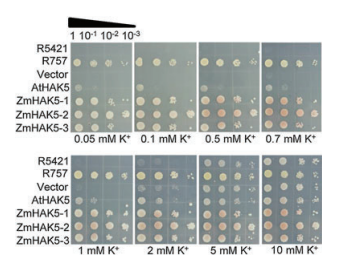
Functional characterization of ZmHAK5 in yeast ZmHAK5 and AtHAK5 complement the Kþ uptakedeficient phenotype of mutant yeast strain R5421 on AP medium containing different K concentrations. Yeast strain R757 was used as a positive control. Three independent experiments were performed. Applicable Fields ▶Functional identification of potassium transport proteins: Determine the in vivo transport function of candidate potassium transport protein genes from plants, microorganisms, and animals, clarifying whether the target gene possesses the core activity to mediate transmembrane potassium uptake. This is a key technical approach for gene function validation. ▶Plant stress physiology research: Analyze the role of potassium transport proteins in maintaining intracellular potassium homeostasis in crops under stresses such as potassium deficiency and heavy metal exposure; screen for genes that confer low-potassium tolerance or efficient potassium utilization in crops, providing targets for nutrient-efficient breeding. ▶Mechanistic analysis of microbial potassium metabolism: Study the potassium transport systems of bacteria, fungi, and other microorganisms to clarify the regulatory mechanisms by which potassium transport proteins help microorganisms adapt to potassium-deficient environments and maintain enzyme activities (e.g., potassium-dependent superoxide dismutase). ▶Functional screening of potassium transport protein mutants/variants: Perform functional verification of different mutants and allelic variants of potassium transport proteins to evaluate the impact of amino acid site mutations on transport activity, aiding in the study of protein structure-function relationships. |