Chinese
 English
|
|
Service Introduction Iron (Fe) is an essential 'micronutrient' for plant growth. It primarily acts as a 'cofactor for enzymes' (such as iron-sulfur proteins and hemoproteins) and is involved in key processes like photosynthesis, respiration, nitrogen metabolism, and DNA synthesis and repair. Although required in small amounts, its role is extremely crucial. Iron deficiency hinders chlorophyll production, reducing photosynthetic efficiency; damages the electron transport chain, disrupting energy metabolism; and can lead to stunted growth. Excessive iron can also catalyze the production of large amounts of reactive oxygen species, causing 'oxidative stress,' damaging membrane structures and cellular functions. Older leaves may develop 'brown or purple spots,' and roots may turn brown, with inhibited growth. Yeast iron salt transfer detection △ccc1 is a genetically engineered Saccharomyces cerevisiae strain used to study metal ion homeostasis. This strain has a deletion of the CCC1 gene via gene knockout technology. The CCC1 gene encodes a manganese/iron transporter located on the vacuolar membrane, whose primary function is to transport and store iron (Fe²⁺) and manganese (Mn²⁺) ions from the cytosol into the vacuole. As a result, the △ccc1 mutant exhibits disrupted intracellular iron homeostasis, particularly reduced vacuolar iron storage capacity, which may also affect iron utilization in organelles such as mitochondria. Yeast iron salt transfer detection △fet3fet4 is a genetically engineered Saccharomyces cerevisiae strain used for studying iron metabolism. This strain has deletions of the main iron transporter genes FET3 and FET4 through gene knockout technology, resulting in a severely impaired ability to uptake iron from the environment, making it an iron absorption-deficient type. This deficiency causes its growth to be highly dependent on the iron concentration in the medium, with restricted growth under low-iron conditions. This strain is mainly used to study iron transport, regulation of iron metabolism, and to screen for exogenous genes or compounds with iron transport functions. Service Advantages ▶Can detect whether a protein has iron ion absorption and transport activity, simple and efficient. ▶Our company has all the reagents, strains, and vectors required for detecting iron ion transport activity. Service Process
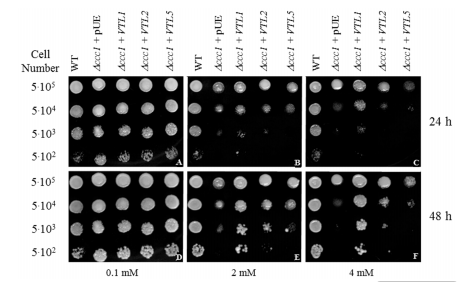
Article Case (1) Yeast iron salt transfer detection Vacuolar-Iron-Transporter1-Like Proteins Mediate Iron Homeostasis in Arabidopsis academic journal:PLOS ONE
Complementation of the Dccc1 by heterologous expression of the VTL genes. Dccc1 (vacuolar Fe2+/Mn2+ transporter) cells were transformed with each of the three VTL genes or the empty vector (pUE) under the control of the PGK promoter and grown on SD medium containing FeSO4 at the concentrations indicated for 24 or 48 h at 30uC. Cells were plated at the densities indicated in the figure. (2) Yeast iron salt transfer detection Characterization of Divalent Metal Transporter 1 (DMT1) in Brugia malayi suggests an intestinal-associated pathway for iron absorption academic journal:IJP: Drugs and Drug Resistance
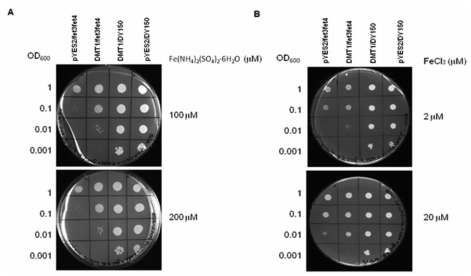
Functional analysis of BmDMT1 in yeast. The fet3fet4 mutant yeast strain was transformed with BmDMT1 or the empty PYES2 expression vector. The DY150 parent strain was used as a positive control and transformed with either BmDMT1 or the empty vector. Serially diluted cells were spotted on URAselective plates supplemented with either A. 100 μM or 200 μM ferrous ammonium sulfate, or B. 2 μM or 20 μM ferric chloride. Applicable Fields ▶Functional Identification of Iron Transport Proteins: Identify the in vivo transport functions of candidate iron transport protein genes from plants, microbes, and animals, clarifying whether the target genes possess the core activity to mediate transmembrane iron ion uptake; this is a key technical approach for gene function validation. ▶Plant Stress Physiology Research: Analyze the role of iron transport proteins in maintaining intracellular iron homeostasis in crops under stress conditions such as iron deficiency and heavy metal stress; screen for crop genes that are tolerant to low iron or efficient in iron utilization, providing targets for breeding for nutrient efficiency. ▶Analysis of Microbial Iron Metabolism Mechanisms: Study the iron transport systems of bacteria and fungi, clarifying the regulatory mechanisms by which iron transport proteins help microbes adapt to iron-deficient environments and maintain the activity of enzymes (such as iron superoxide dismutase). ▶Functional Screening of Iron Transport Protein Mutants/Variants: Conduct functional validation of various mutants and allelic variants of iron transport proteins, evaluate the impact of amino acid site mutations on transport activity, and support research on protein structure-function relationships.
|