Chinese
 English
|
Service Introduction Specifically designed for screening and validating cadmium transport proteins, based on the principle of heterologous complementation in yeast. It includes a cadmium transport-deficient strain △ycf1, the pYES2 vector, and cadmium-containing or cadmium-free media. The deficient strain grows normally in a cadmium-free environment. After transforming the target gene, active proteins can transport a large amount of cadmium into the cell, inhibiting the growth of the strain. Other metal interference is excluded, making it suitable for the initial screening, validation, and cadmium metabolism studies of transport proteins. Service Advantages ▶Can detect whether the protein has cadmium ion absorption and transport activity, simple and efficient. ▶Our company has all the reagents, strains, and vectors required for cadmium ion transport activity detection. Service Process
Article Case Metallochaperone protein OsHIPP17 regulates the absorption and translocation of cadmium in rice (Oryza sativa L.) academic journal:International Journal of Biological Macromolecules
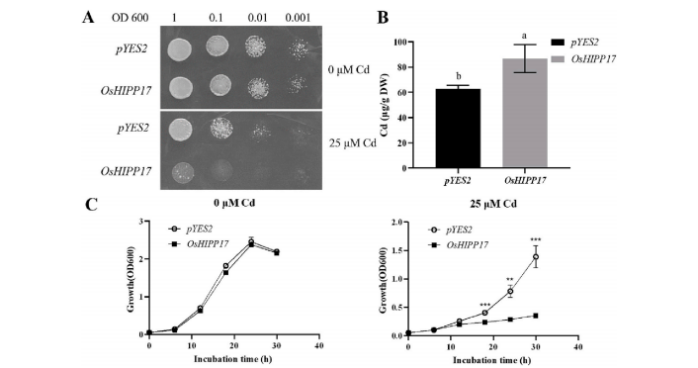
Functional analysis of OsHIPP17 in yeast. (A) The effects of OsHIPP17 on the sensibility of Cd in yeast. (B) The Cd concentration in yeast cells. Different letters (a, b) indicate significant differences (p < 0.05). (C) The growth rate of yeast cells when treated with Cd. OD 600 (Optical density 600) can be used to measure the concentration of yeast cells. OD 600 = 1, 0.1, 0.01 and 0.001 denote the cell concentration of yeast culture at 600 nm, respectively. and indicate significant.differences at p < 0.05 and p < 0.001, respectively. Error bars represent standard deviation of three biological replicates. Statistical comparison was performed by t-tests. Applicable Fields ▶Function identification of cadmium transporter: It is the key technical means to identify the in vivo transport function of candidate cadmium transporter genes plants, microorganisms, and animals, and to clarify whether the target gene has the core activity of mediating the transmembrane absorption of cadmium ions. ▶Plant stress physiology research: Analyze the role of cadmium transport proteins in maintaining intracellular cadmium ion homeostasis under stress conditions such as cadmium deficiency and heavy metal stress in crops; screen crop genes that are tolerant to low cadmium or efficiently utilize cadmium to provide targets for breeding for nutrient-efficient utilization. ▶Mechanism analysis of microbial cadmium metabolism: Study the cadmium transport system of bacteria, fungi and other microorganisms, and the regulatory mechanism of cadmium transport proteins in microbial adaptation to cadmium-deficient environment and maintenance of enzyme activity. ▶Functional screening of cadmium transport protein mutants/variants: Conduct functional verification of different mutants and allelic variants of cadmium transport proteins, evaluate the impact of amino acid site mutations on transport activity, and support studies on protein structure-function relationships. |