Chinese
 English
|
|
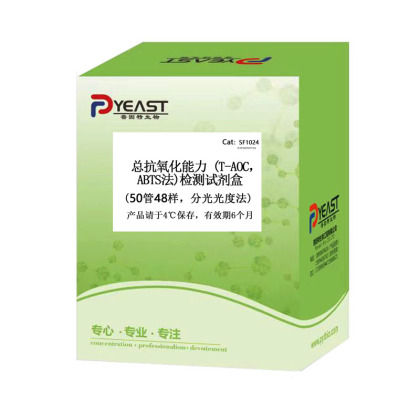
Total Antioxidant Capacity (T-AOC, ABTS Method) Assay Kit
Total Antioxidant Capacity (T-AOC, ABTS Method) Assay Kit
The total antioxidant level in the test object is composed of various antioxidant substances and antioxidant enzymes. In biological, medical, and pharmaceutical research, the total antioxidant capacity is often detected in various body fluids such as plasma, serum, saliva, and urine; lysates of cells or tissues; extracts of plants or Chinese herbal medicines; and solutions of various antioxidants. The ABTS method is the most widely used indirect detection method, applicable for determining the antioxidant capacity of both hydrophilic and lipophilic substances. ABTS is oxidized to form the stable blue-green cation radical ABTS⁺, which is soluble in aqueous phase or acidic ethanol medium and has a maximum absorption at 734 nm. When the test substance is added to the ABTS⁺ solution, the antioxidant components contained therein react with ABTS⁺, causing decolorization of the reaction system. The change in absorbance is measured at 734 nm, and the antioxidant capacity of the antioxidant substances is quantified using Trolox as a reference system.
1. This product is for scientific research use only. Please do not use it for medical, clinical diagnosis or treatment, food and cosmetics, etc. Please not store it in a general residential area. 2. For your safety and health, please wear a lab coat and disposable gloves and masks when operating. 3. The experimental can be affected by a variety of factors, and the relevant treatment is limited to the product itself, and does not involve other compensation. |