Chinese
 English
|
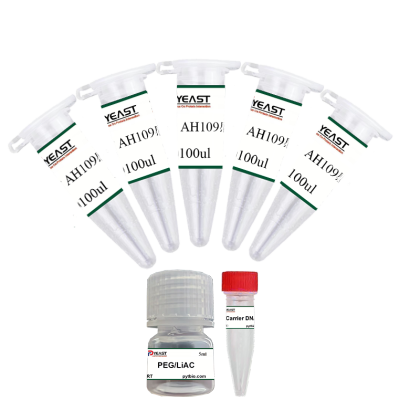
AH109 Chemically Competent Cell
AH109 Chemically Competent Cell
 The AH109 strain is derived from the PJ69-2A yeast strain, and the introduction of the lacZ reporter gene into PJ69-2A gave rise to AH109. This strain is developed by Clontech for use in the GAL4 system yeast two-hybrid experiments, is of MATa type, and can be directly transformed with plasmids or mated with the MATα type yeast strain Y187 for protein interaction validation or library screening. The transformation markers are: trp1, leu2, and the reporter genes are: lacZ, HIS3, ADE2, MEL1. The AH109-GAL4 yeast two-hybrid system requires the use of two compatible plasmids: pGBKT7 and pGADT7. The selection marker for plasmid pGBKT7 is TRP1, which is used to express the fusion protein of DNA-BD (the N-terminal 1-174 amino acids from the yeast transcription factor GAL4) and the target protein (Bait); the selection marker for plasmid pGADT7 is LEU, used to express the fusion protein of AD (the C-terminal 768-881 amino acids) and the target protein (Prey). The principle of the GAL4 system: a complete yeast transcription factor GAL4 can be divided into two functionally independent domains: the DNA-binding domain (DNA-BD) located at the N-terminal 1-174 amino acid region and the transcription activation domain (AD) located at the C-terminal 768-881 amino acid region. DNA-BD can recognize the upstream activation sequence UAS of GAL4-responsive genes and bind to it. AD can initiate the transcription of genes downstream of UAS. BD and AD cannot activate transcription when they exist separately, but when they are close together, they exhibit complete GAL4 activity, activating the transcription of downstream genes of promoters containing UAS. Under normal conditions, BD does not bind to AD. The proteins to be tested are fused separately with BD and AD, forming the bait fusion protein (bait-BD) and prey fusion protein (prey-AD); if bait and prey interact, it promotes the proximity of BD and AD, forming complete GAL4, thereby activating the transcription of the reporter gene. AH109 has four reporter genes: lacZ, HIS3, ADE2, MEL1, which are initiated by three different promoters (GAL1, GAL2, MEL1). Only the 17 bp core region that GAL4 recognizes is the same among these three promoters, while the other parts are different, significantly reducing the likelihood of false positives in the yeast two-hybrid system. The competent AH109 cells are produced via a special process and can be stored at -80°C for 12 months, with the pGADT7 plasmid (7988 bp, AmpR) achieving a transformation efficiency of >104 cfu/μg DNA.
1. This product is for scientific research use only. Please do not use it for medical, clinical diagnosis or treatment, food and cosmetics, etc. Please not store it in a general residential area. 2. For your safety and health, please wear a lab coat and disposable gloves and masks when operating. 3. The experimental can be affected by a variety of factors, and the relevant treatment is limited to the product itself, and does not involve other compensation. |