Chinese
 English
|
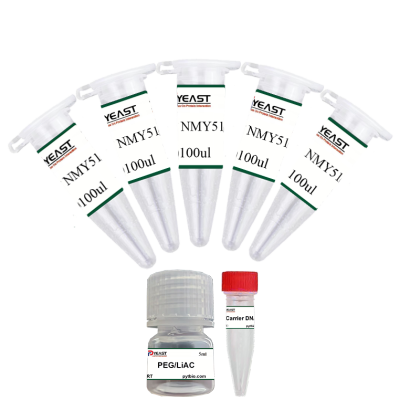
NMY51 Chemically Competent Cell
NMY51 Chemically Competent Cell
The DUAL membrane system is a detection technology specifically developed by DUAL Systems BioTech for screening interactions between transmembrane proteins. It directly detects the interactions of membrane proteins in their natural state using a split-ubiquitin system and is currently the only yeast two-hybrid system on the market for detecting interactions between membrane proteins. This system employs the NMY51 yeast strain, which allows for direct transformation of plasmids for protein interaction validation or library screening experiments; the transformation markers for this strain are: trp1, leu2-3, with reporting genes being: HIS3, ADE2, and lacZ. In the first step, selective growth screening is performed using the nutrient-deficient reporting genes (HIS3, ADE2), followed by quantitative or semi-quantitative screening using LacZ reporting genes for β-galactosidase analysis, where three independent reporting genes are regulated by different promoters to reduce the chances of false positives. The principle is that ubiquitin, consisting of 76 amino acids, has a very small molecular weight; as a degradation signaling molecule, ubiquitin can connect to the N-terminus of another protein and then be recognized by ubiquitin-specific proteases (UBPs), which leads to the enzyme cleavage of the protein linked to ubiquitin. Ubiquitin can artificially be split into two parts: the N-terminal (Nub) and the C-terminal (Cub). First, the isoleucine at the third position of Nub is mutated to glycine (NubI is mutated to NubG). This significantly reduces the affinity with Cub and avoids the possibility of self-binding or proximity between Cub and Nub. Next, the Cub part is fused with the synthetic transcription activation factor LexA-VP16 to form a fusion protein Cub-LexA-VP16. Under normal conditions, NubG does not bind to Cub, and UBPs cannot recognize the separated ubiquitin, meaning the transcription activation factor is not cleaved. Finally, the proteins to be tested are separately fused with NubG and Cub, forming bait fusion proteins (bait-cub-LexA-VP16) and prey fusion proteins (prey-NubG). If bait and prey interact, NubG and Cub will come closer, be recognized by UBPs, which leads to the dissociation of LexA-VP16, entering the nucleus and activating the transcription of the reporting gene. This system can use four types of bait plasmids: pBT3-N, pBT3-SUC, pBT3-STE, and pBT3-C, with selection markers being LEU; and three types of prey plasmids: pPR3-C, pPR3-SUC, and pPR3-STE, with selection markers being TRP. NMY51 competent cells are prepared with a special process and can be stored at -80°C for 12 months, with the pGADT7 plasmid (7988 bp, AmpR) allowing detection of transformation efficiency greater than 104 cfu/μg DNA.
1. This product is for scientific research use only. Please do not use it for medical, clinical diagnosis or treatment, food and cosmetics, etc. Please not store it in a general residential area. 2. For your safety and health, please wear a lab coat and disposable gloves and masks when operating. 3. The experimental can be affected by a variety of factors, and the relevant treatment is limited to the product itself, and does not involve other compensation. LastpGro7vectorNextptdTomato-N1 Vector |