Chinese
 English
|
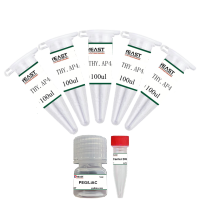
THY.AP4 Chemically Competent Cell
THY.AP4 Chemically Competent Cell
The Split Ubiquitin System (mbSUS) is a detection technology specifically designed to screen for interactions between transmembrane proteins. It uses a separated ubiquitin system to directly detect interactions between membrane proteins in their native state through a yeast two-hybrid system. This system employs the THY.AP4 yeast strain, which can directly transform plasmids for protein interaction validation or library screening experiments. The genotype of this strain is: MATa; ade2-, his3-, leu2-, trp1-, ura3-; lexA::ADE2, lexA::HIS3, lexA::lacZ. The first step involves selective growth screening using nutritional deficiency reporter genes (HIS3, ADE2), followed by β-galactosidase analysis using the LacZ reporter gene for colorimetric quantitative or semi-quantitative screening. There are three independent reporter genes regulated by different promoters to reduce the likelihood of false positives. The plasmids that can be used in this system include: pNXgate32-3HA, pXNgate21-3HA, and pMetYCgate. THY.AP4 competent cells are produced by special methods and can be stored at -80°C for 12 months, with a transformation efficiency of the pGADT7 plasmid detecting >104 cfu/μg DNA.
1. This product is for scientific research use only. Please do not use it for medical, clinical diagnosis or treatment, food and cosmetics, etc. Please not store it in a general residential area. 2. For your safety and health, please wear a lab coat and disposable gloves and masks when operating. 3. The experimental can be affected by a variety of factors, and the relevant treatment is limited to the product itself, and does not involve other compensation. |