Chinese
 English
|
Service Introduction Chromosome walking, also known as genome walking, is a method that involves starting from a known sequence in a biological genome or genomic library to progressively identify adjacent unknown sequences or target sequences with a linear relationship to the known sequence. For model organisms with completed genome sequences (e.g., humans, mice, nematodes, rice, Arabidopsis thaliana), the flanking sequences of known regions can be readily retrieved from databases. However, the DNA sequences of most organisms in nature remain unknown; thus, chromosome walking remains an exceptionally effective approach for determining the DNA sequences flanking a known region. Service Advantages ▶Our company's professional technical team possesses extensive experience in walking technology, particularly through years of hands-on practice with TAIL-PCR (interlaced thermal asymmetric PCR), accumulating profound expertise through long-term experimental applications. ▶Efficient and rapid methods to maximize the likelihood of obtaining the desired sequence; ▶For unknown sequences containing advanced structures, a unique, fast, and efficient approach has been developed. Service Process
Article Case Chromosomal Walking and Jumping to Isolate DNA from the Ace and rosy Loci and the Bithorax Complex in Drosophila melanogaster academic journal:Journal of Molecular Biology
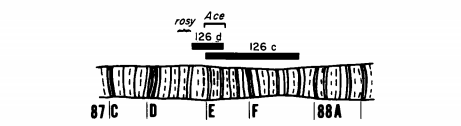
Cytological Ioealizations in 87D-E. The extents of the two deficiencies Df(3R)126c and Df(3R)126d are indicated by horizontal bars. The region where they overlap (87E1-6) includes the locus coding for acetyleholinesterase (Ace) and also included DNA homologous to cDm758, the starting point of the chromosomal walk. The locus doding for xanthine dehydrogenase (rosy) is just to the left of the 126d deficiency, in 87D10-12. Applicable Fields ▶(1) Identify the insertion sites of T-DNA or transposons, and determine the insertion sites of exogenous genes introduced by transgenic technology; (2) Clone the target gene based on known gene fragments, ESTs, or the inserted transposon sequences, and isolate the gene promoter and regulatory elements. ▶Used for fragment ligation in artificial chromosomes such as PAC, YAC, and BAC. ▶Map the overlapping clusters in the genomic clone. ▶STS or SCAR markers used in transformation marker-assisted breeding. |