Chinese
 English
|
|
Service Introduction The K667 yeast calcium transport complementation assay is a classical experimental system used to determine whether a target gene encodes a functional calcium (or other cation) transporter. The underlying principle is straightforward: K667 cells are inherently sensitive to high calcium concentrations, with their growth being inhibited. If the introduction of an exogenous gene can "reconstitute" the deficient calcium transport function and restore growth under high-calcium conditions, it indicates that the gene is likely involved in calcium transport. Service Advantages ▶ Capable of detecting whether proteins possess calcium ion absorption and transport activity, with simple and efficient operation. ▶Our company possesses all the reagents, strains, and vectors required for calcium ion transport activity assays. Service Process
Article Case Arabidopsis calcium-dependent protein kinases 4/5/6/11 negatively regulate hydrotropism via phosphorylation of MIZU-KUSSEI1 academic journal:The Plant Cell
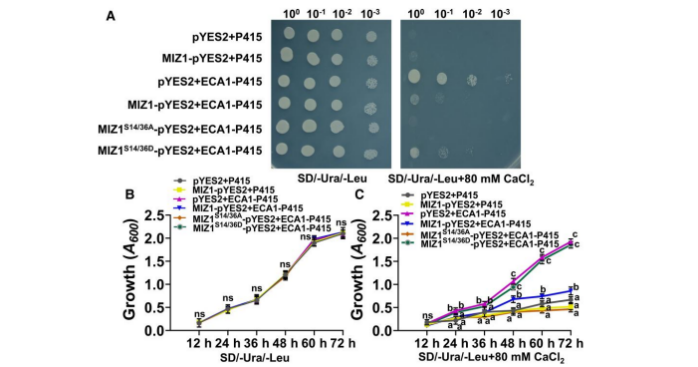
CPK-mediated phosphorylation of MIZ1Ser14/36 is essential for facilitating ECA1 activity. A) Functional analysis of MIZ1 phosphorylated by CPKs on ECA1 activity in yeast. Growth of yeast strains on normal medium (lacking Ura and Leu, SD/−Ura/−Leu) and treatment medium (SD/−Ura/−Leu + 80 mM CaCl2) for 3 to 5 d. The strain used was K667 (Δpmc1vcx1cnb1), and K667 cells transformed with the empty pYES2 or P415 vectors served as the negative control. From left to right, there is a 10-fold dilution series of yeast cultures. B and C) Growth curves of yeast cells were plotted against the A600 values in the SD/−Ura/−Leu (B) and SD/−Ura/−Leu + 80 mM CaCl2 nutrient solution (C). The A600 values of yeast cell growth were monitored from 12 to 72 h. The data are presented as mean±SD (n=3 biological replicates). One-way ANOVA and the LSD test for multiple comparisons were performed, and significant differences are indicated by letters (α=0.01), while “ns” indicates no significant differences. Applicable Fields ▶Calcium transporter function validation: Determining the in vivo transport function of candidate calcium transporter genes derived from plants, microorganisms, and animals, and confirming whether the target genes possess the core activity required for mediating calcium ion transmembrane absorption, constitutes a pivotal technical approach for gene function validation. ▶Research on Plant Stress Physiology: Investigate the role of calcium transporters in maintaining intracellular calcium homeostasis under stress conditions such as calcium deficiency and heavy metal exposure; screen crop genes with low-calcium tolerance or high calcium utilization efficiency to identify targets for nutrient-efficient breeding. ▶Analysis of microbial calcium metabolism mechanisms: Investigate the calcium transport systems in microorganisms such as bacteria and fungi, elucidating the regulatory mechanisms of calcium transport proteins in microbial adaptation to calcium-deficient environments and maintenance of enzyme activity. ▶Functional screening of calcium transporter mutants/variants: Conduct functional validation of various calcium transporter mutants and allelic variants to evaluate the impact of amino acid site mutations on transport activity, thereby facilitating research on the structure-function relationship of proteins. |