Chinese
 English
|
Service Introduction Bacillus subtilis is a Gram-positive bacterium with a Generally Recognized As Safe (GRAS) status, widely utilized in the production of industrial products such as enzyme preparations, vitamins, and antibiotics. Puyint Bio possesses mature Bacillus subtilis gene-editing technologies, enabling targeted modifications to the bacterial genome—including gene knockout, insertion of exogenous sequences, and introduction of point mutations—to achieve functional optimization of strains and reconstruction of metabolic pathways. ervice Advantages ▶ Extensive Experience: Possesses extensive expertise in Bacillus subtilis gene editing, with a seasoned team capable of efficiently constructing Bacillus subtilis mutants. ▶Quality Assurance: All gene-editing sites are rigorously sequenced and validated to ensure product quality. Service Process
Article Case Editing of the Bacillus subtilis Genome by the CRISPR-Cas9 System academic journal:Applied and Environmental Microbiology
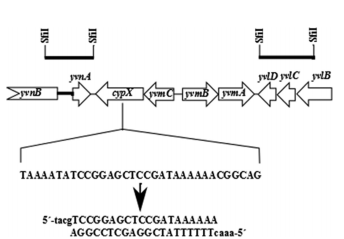
B. subtilis chromosomal region carrying the pulcherrimin biosynthesis genes. The bars on the top indicate the fragments amplified by PCR and integrated between the SfiI sites of pJOE8999 to delete the genes cypX and yvmA. The sequence in cypXwas selected as a target for the Cas9/sgRNA complex, and the oligonucleotides inserted into pJOE8999 are shown below. Lowercase letters indicate the deoxynucleotides fitting to the BsaI sites. Applicable Fields ▶Industrial Enzyme Preparations and Chemical Production: Gene editing of Bacillus subtilis is widely applied in strain improvement for industrial products such as enzyme preparations, vitamins, and antibiotics. For example, through genome-scale metabolic network optimization and CRISPR editing, researchers have developed riboflavin-high-yield strains with production rates reaching 18.5 g/L. In lycopene synthesis studies, base editing technology was employed to simultaneously regulate 12 key metabolic genes, successfully yielding engineered strains with a 6.2-fold increase in lycopene yield. ▶Metabolic pathway optimization and chassis cell construction: To address issues such as metabolic redundancy and low transformation efficiency in Bacillus subtilis, genome streamlining can be employed to obtain small-genome strains serving as chassis cells. By integrating synthetic biology elements such as promoter libraries and RBS libraries, the metabolic network can be systematically optimized to enhance target product yields. ▶Gene Function Research: By constructing gene knockout mutant strains, the biological functions of specific genes are investigated. For example, studies utilizing homologous recombination methods have generated Bacillus subtilis ituD gene knockout mutant strains, revealing a significant reduction in antimicrobial activity, thereby laying the foundation for further research on the function of the ituD gene. ▶Probiotic Development and Biological Control: Gene editing technology can be utilized to develop superior probiotic strains or modify biological control strains to enhance their stability and efficacy, enabling their application in agricultural biological control practices. |