Chinese
 English
|
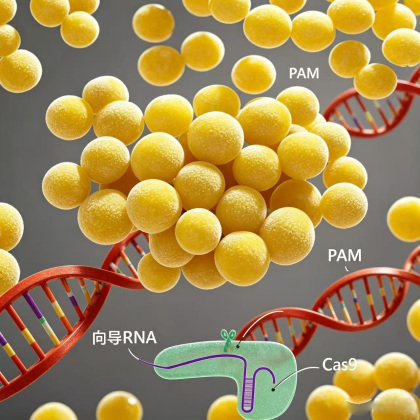
Service Introduction Staphylococcus aureus (abbreviated as "S. aureus"), recognized as both a "superbug" and a "model organism," plays a pivotal role in public health security, fundamental biological understanding, and the advancement of the biotechnology industry. Punter Biotech employs third-generation editing technologies represented by the CRISPR/Cas9 system, which, due to their high efficiency and simplicity, enable targeted modifications to the S. aureus genome—including gene knockout, insertion of exogenous sequences, and introduction of point mutations—to achieve strain functional optimization and metabolic pathway reprogramming. Service Advantages ▶Extensive Experience: Possesses extensive expertise in the field of Staphylococcus aureus gene editing, with a seasoned team capable of efficiently constructing Staphylococcus aureus mutants; ▶ Quality Assurance: Ensures that all gene editing sites are sequenced and validated to guarantee product quality. Service Process
Article Case Rapid and Efficient Genome Editing in Staphylococcus aureus by Using an Engineered CRISPR/Cas9 System academic journal:Journal of the American Chemical Society
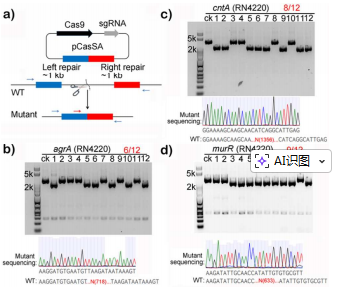
CRISPR/Cas9-mediated genome editing in the S.aureus RN4220 strain. (a) The scheme of editing procedures. The blue arrows are the primers utilized for PCR validation of editing efficiency. The red arrow is the primer used for sequencing. (b) pCasSA-mediated disruption of agrA gene in the RN4220 strain. The editing efficiency is 6/12. The lane of ck is the PCR product from the wildtype strain as a control. (c) pCasSA-mediated disruption of cntA gene in the RN4220 strain. The editing efficiency is 8/12. (d) pCasSA-mediated disruption of murR gene in the RN4220 strain. The editing efficiency is 9/12. Applicable Fields ▶Research on Pathogenic Mechanisms and Drug Resistance: Investigate the relationship between specific genes and pathogenicity through gene knockout studies. For example, research conducted on drug-resistant strains such as methicillin-resistant Staphylococcus aureus (MRSA). ▶Vaccine Development and Drug Target Discovery: Modifying pathogen genomes to develop live attenuated vaccines, or identifying novel drug targets through large-scale knockout screening. ▶Industrial strain improvement and food microbiology research: Optimizing metabolic pathways to enhance bioproduct yields, or eliminating genes associated with toxin production to mitigate food safety risks. ▶Gene function research: Investigate the biological functions of genes by constructing mutant strains and combining them with phenotypic analysis. |