Chinese
 English
|
Service Introduction Lactic acid bacteria (LAB) are a class of microorganisms highly beneficial to both human health and the food industry, capable of fermenting sugars with lactic acid as their primary product. They offer advantages such as safety, ease of cultivation, and diverse metabolic capabilities. Punter Biotech employs third-generation editing technologies represented by the CRISPR/Cas9 system, which enables precise genomic modifications in LAB—including gene knockout, insertion of exogenous sequences, and introduction of point mutations—with high efficiency and simplicity, thereby optimizing strain functionality and reconstructing metabolic pathways. Service Advantages ▶Extensive Experience: Possesses extensive expertise in the field of lactic acid bacteria gene editing, with a seasoned team capable of efficiently constructing lactic acid bacterial mutants; ▶ Quality Assurance: Ensures that all gene editing sites are sequenced and validated to guarantee product quality. Service Process
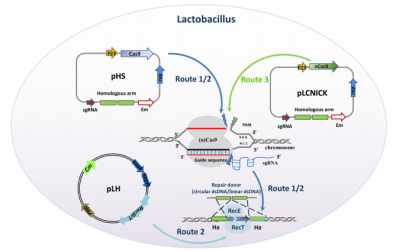
Article Case lopment of a RecE/T‐Assisted CRISPR–Cas9 Toolbox for Lactobacillus academic journal:Biotechnology Journal Overview of CRISPR–Cas9 editing toolbox for Lactobacilli. The CRISPR–Cas9 editing toolbox consists of three pathways for genome editing in Lactobacillus.“ Route 1” represents the all‐in‐one editing plasmid (pHS series) strategy applicable for the species, in which endogenous recombination machinery is qualified for DSB repair.“ Route 2” represents the association of the all‐in‐one editing plasmid (pHS series) and RecE/T ‐ based assistant plasmid (pLH series) strategy, applicable for the species in which endogenous recombination is deficient in DSB repair. The RecE/T recombinases mediate HDR of DSB by employing homologous arms provided by the editing plasmid.“ Route 3” based on nickase‐induced chro mosomal single‐strand break (nick), is an alternative strategy applicable for the species in which the chromosomal nick is able to effectively stimulate HDR, realizing genetic modification. Applicable Fields ▶Basic scientific research: Can be utilized for studying specific gene functions, analyzing and optimizing metabolic pathways, or enabling bacterial strains to carry fluorescent markers for in vivo tracking. ▶Probiotics and Pharmaceutical Development: Used to develop next-generation probiotics with superior therapeutic efficacy, or to engineer them into "living drug" carriers for delivering bioactive molecules such as vaccines and antibodies. ▶ Food Industry: Improve the quality of fermented foods by optimizing metabolic pathways to enhance the yield of target products (e.g., γ-aminobutyric acid, vitamins) or by eliminating genes responsible for off-flavors or flavor impairment
|