Chinese
 English
|
Service Introduction The bacterial single-hybridization system is a tool for studying nucleic acid–protein interactions, developed from research using Escherichia coli, and is widely employed to investigate the regulation of gene expression in prokaryotic cells—such as identifying DNA binding sites to discover potential binding protein genes or analyzing information regarding DNA-binding domains. Service Advantages ▶High throughput, short cycle, rapid identification of interaction targets: Leveraging the rapid growth characteristics of E. coli, initial library screening can be completed in 3-5 days, with validation results available within a week. ▶In vivo detection, real environmental conditions, strong specificity, and low background: Protein interactions are directly validated in the active bacterial cellular environment, better reflecting a close-to-natural folding state and interaction context. ▶Fom validation to discovery, providing a one-stop solution: We not only provide interaction validation for known protein pairs but also excel at performing large-scale library screenings (such as genomic libraries or mutant libraries) and can precisely identify key interaction domains or residues. ▶Professional team support throughout, with clear and reliable data delivery: Equipped with an experienced team of project scientists, we provide one-on-one professional support from experimental design to data analysis. Service Process
Article Case Arsenite oxidation regulator AioR regulates bacterial chemotaxis towards arsenite in Agrobacterium tumefaciens GW4 academic journal:Scientific Reports
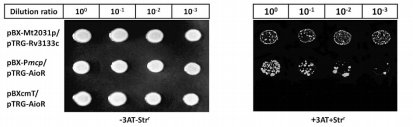
Bacterial one-hybrid assay. Co-transformants containing pBX-Mt2031p/pTRG-Rv3133c were employed as positive controls (CK+), while co-transformants containing pBXcmT/pTRG-AioR was used as negative controls (CK−). Cells of CK+, pBX-Pmcp/pTRG-AioR, and CK- were grown to OD600 of 1.0 and 2μL of each was spotted onto His-selective medium (+3AT, +Strr) and LB plate (−3AT, −Strr). (B–E) EMSA assays. FAM-labeled aioBA probe. Applicable Fields ▶Transcription factor research: Bacterial single-hybridization assays can be used to investigate the specific binding of transcription factors to DNA sequences. By constructing a "deterrent" containing promoter or enhancer sequences that interacts with the target transcription factor, the interaction between transcription factors and gene regulatory sequences can be identified and validated. ▶DNA-binding protein identification: Bacterial single hybridization can be used to identify proteins that interact with specific DNA sequences. By constructing a "deterrent" containing a DNA-binding sequence that interacts with proteins from the "prey," it is possible to screen and validate proteins that bind specifically to that particular DNA sequence. ▶Drug screening and discovery: Identification of drugs targeting specific transcription factor–DNA interactions, particularly suitable for transcription factor targets that have traditionally been challenging to target with drugs. |